
To place an order, email [email protected]
Sourdough starter kits are $12.99, free US shipping.

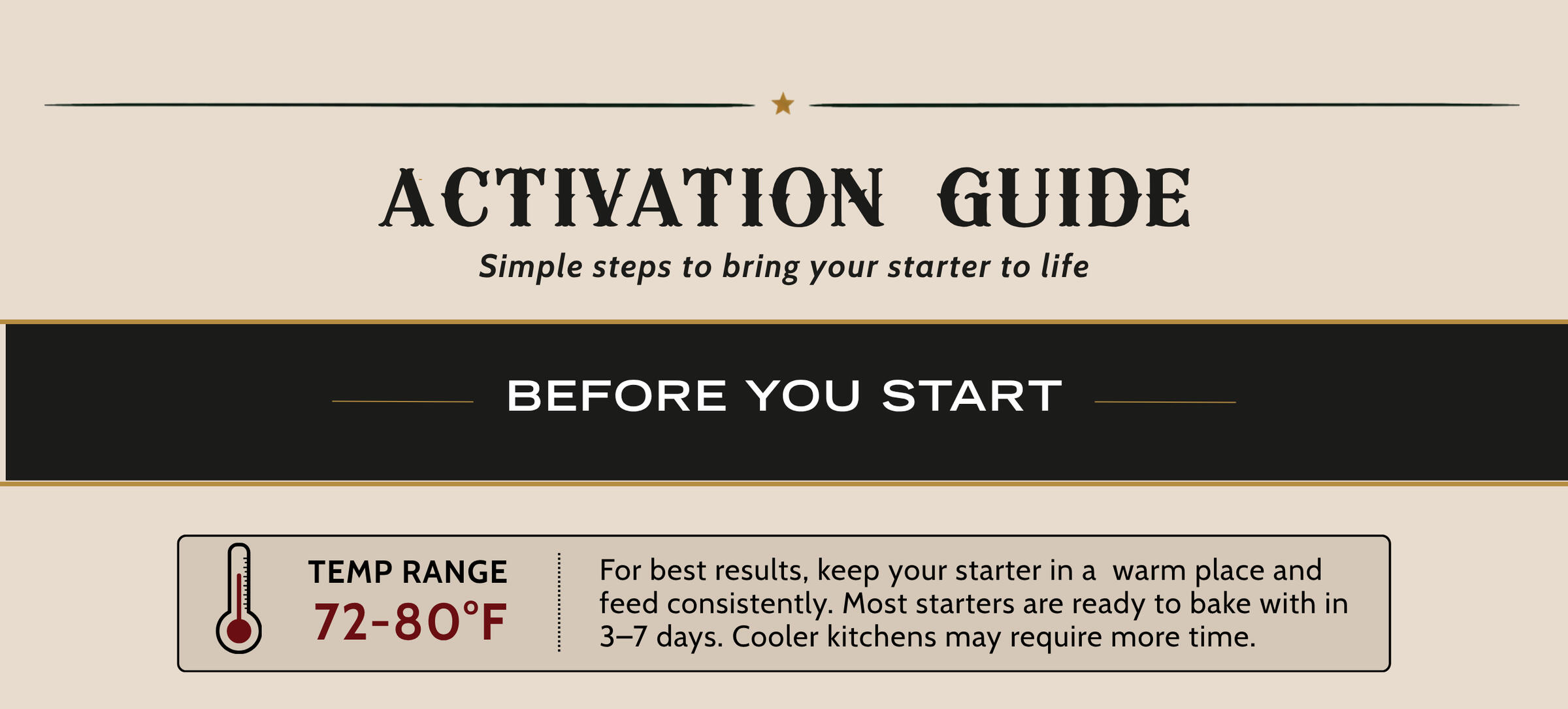
Activation usually takes 3-7 days but could be longer in cooler kitchens.
Little or no visible activity during the first several days is completely normal.Follow the feeding instructions, and if you are concerned at any point contact us before starting over. We're happy to help!

Clean glass jar with a solid lid
Warm bottled or filtered water, around 85°
Bread flour or unbleached all-purpose flour
Measuring cups or kitchen scale (preferred)
Spoon or spatula

Chlorinated tap water and bleached flour can inhibit activation. Before you begin, ensure your flour is unbleached and your water is unchlorinated (bottled or filtered).
Cover the jar loosely. Do not tighten the lid. Your starter needs room for gas to escape as it becomes active.
If your kitchen is cold, look for warm spots such as next to (but not touching) an appliance, or near the stove.
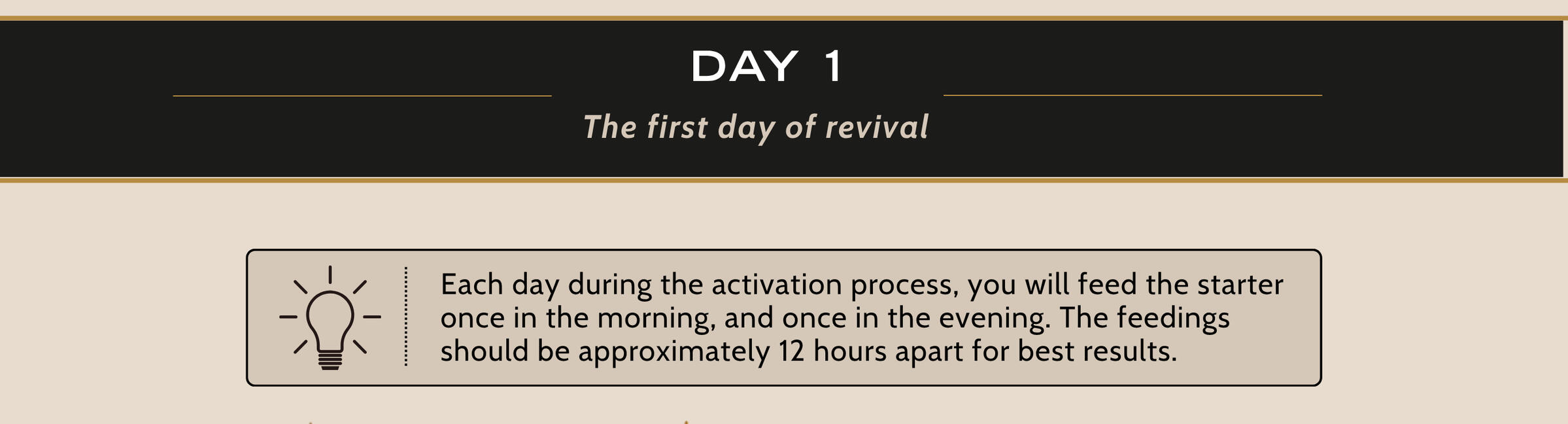

1. In a clean glass jar, combine:
Full packet of Gold Rush Starter
3 tablespoons (45g) warm 85° bottled or filtered water
4 tablespoons (30g) unbleached flour
For best results use a kitchen scale.
2. Mix well and cover loosely with a solid lid.
Keep in a warm place.

1. Add to your starter:
2 tablespoons (30g) warm bottled or filtered water
4 tablespoons (30g) unbleached flour
For best results use a kitchen scale.
2. Mix well and cover loosely with a solid lid.
Keep in a warm place.

It is normal to see no visible activity today. The microbes in your starter are rehydrating. Warmth and consistency matter most at this stage.
If measuring by volume, use loosely filled tablespoons of flour, do not pack the flour. Flour volume varies so 30g may measure approximately 3-4 tablespoons.
Your starter may look like a thick dough, this is normal.
For best results, choose a jar with a solid lid. Porous materials such as cloth can introduce mold.


1. Keep 2 tablespoons (30g) of your starter*. Discard the rest.
2. Add to the starter:
2 tablespoons (30g) warm (85°F) bottled or filtered water
4 tablespoons (30g) unbleached flour
3. Mix well and cover loosely. Keep in a warm place.
*COOL KITCHEN (BELOW 72°F) Retain 60g starter instead of 30g. Add the same 30g water and 30g flour shown above.

Repeat the Morning Feeding:
1. Keep 2 tablespoons (30g) of your starter*. Discard the rest.
2. Add to the starter:
2 tablespoons (30g) warm (85°) bottled or filtered water
4 tablespoons (30g) unbleached flour
3. Mix well and cover loosely. Keep in a warm place.
*COOL KITCHEN (BELOW 72°F) Retain 60g starter instead of 30g. Add the same 30g water and 30g flour shown above.

Activity may begin on Day 2. You may see small bubbles, a mild sour smell, or slight rising. This is a good sign, but the starter may still need more time before it is ready to bake.
If you are not yet seeing activity, double-check the following:
Flour is unbleached
Water is bottled or filtered (unchlorinated)
Starter is in a warm location
In colder homes, it is not unusual for activation to take longer. Continue to follow the process.
This is the day you begin discarding. Discarding keeps the starter at a manageable size and ensures it receives enough fresh flour and water with each feeding.


1. Keep 1 tablespoons (15g) of your starter*. Discard the rest.
2. Add to the starter:
2 tablespoons (30g) warm (85°) bottled or filtered water
4 tablespoons (30g) unbleached flour
3. Mix well and cover loosely. Keep in a warm place.
*COOL KITCHEN (BELOW 72°F) Retain 30g starter instead of 15g. Add the same 30g water and 30g flour shown above for both Day 3 feedings.For Days 4+ follow the regular instructions above (15g starter, 30g water, and 30g flour).

Repeat the above steps until your starter meets the above criteria.

In colder homes, it is not unusual for activation to take longer.
If you are not yet seeing much activity, double-check the following:
Flour is unbleached
Water is bottled or filtered (unchlorinated)
Starter is in a warm location
Contact us if you are concerned about your starter's progress. Remember, your starter is dormant, not dead. Let us help before you start over!

Once your sourdough starter is active, it needs to be fed regularly to keep it alive and ready to bake. Store your starter on the counter if you bake more than once a week, or in the refrigerator if you bake less frequently.

Best choice if you bake more than once a week.Every 24 hours:
Keep 1 tablespoon (15g) of your starter. Discard the rest.
Add 2 tablespoons (30g) warm, bottled or filtered water (around 85F)
Add 4 tablespoons (30g) bread flour or unbleached all-purpose flour
Mix well and cover loosely with a solid lid
Store in a warm place, around 75F

Best choice if you bake less frequently.Once per week:
Keep 1 tablespoon (15g) of your starter. Discard the rest.
Add 2 tablespoons (30g) warm, bottled or filtered water (around 85F)
Add 4 tablespoons (30g) bread flour or unbleached all-purpose flour
Mix well and cover with a solid lid
Let rest at room temperature for 1-2 hours before returning to the refrigerator.

Before baking from the refrigerator, you will need to reinvigorate it.
Feed it at room temperature 1-2 times until it is bubbly, active, and doubling within 4-8 hours after feeding.
If your starter has been refrigerated for several weeks, it may take a couple feedings to be fully active again. This is normal.

Before you begin, make sure your starter is active, bubbly, and reliably doubling within 4–8 hours after feeding.When you're ready to bake, follow your normal feeding outine. Once your starter has risen and is at or near its peak, use 1/4 cup (60g) for the recipe. The remaining 1 tablespoon (15g) can be maintained as your starter.
Recommended Tools:
Large bowl
Two loaf pans (standard pound sized, 9"x5")
Sharp knife or bread lame
Ingredients:
1/4 cup (60g) active sourdough starter, at peak
1 cup (250g) room-temperature water
2 1/2 cups (375g) bread flour or unbleached all-purpose flour
8g fine salt
Method:
1. Mix
In a large bowl, combine the active starter and water.
Add the flour and salt, and mix until no dry flour remains. The dough will look rough and shaggy.
Knead the dough for 2-3 minutes. The dough will become smoother.
2. Rest
Cover the bowl and let the dough rest for 30 minutes. This gives the flour time to absorb the water and makes the dough easier to work with.
3. Stretch and Fold
Over the next 2 hours, perform 3-4 rounds of stretch and folds.
To do this, grab one side of the dough, gently stretch it upward, and fold it into the center. Turn the bowl 90 degrees and repeat on all sides.
Cover and let the dough rest for 30 minutes between each set of stretch and folds.
4. Bulk Rise
Cover the bowl and let the dough rise at room temperature until it has increased in size about 75%.
This usually takes between 6 and 12 hours, depending on room temperature. Colder kitchens will require longer.
5. Shape
Turn the dough onto a very lightly flour work surface.
Gently stretch the sides outward, forming a rectangle.
Fold the sides in toward the center, like a pamphlet, then roll the dough away from yourself into a log.
Pinch the ends to seal.
6. Final Proof
Place the shaped loaf in a greased loaf pan, seam side down.
Cover and transfer to refrigerator for 24-36 hours.
7. Bake
Preheat oven to 450°F
With a sharp knife, make a long slit down the entire center of your loaf, about 1/2" deep.
Invert the second loaf pan and place it on top, creating a lid.
Transfer to center rack of oven and bake for 20 minutes.
Carefully remove the lid, lower heat to 415°F, and bake another 15 minutes until golden.
9. Cool
Let the loaf cool on a wire rack for at least 90 minutes before slicing. Cutting too early can make the inside gummy.
Enjoy your bread!

Sticky dough? Damp hands make handling dough easier
Ensure your oven is fully preheated for best rise
For a milder flavor, reduce second proof (refrigerator) time to 6 hours.
For a stronger flavor, increase to up to 48 hours.
No loaf pans? second proof your dough in a banneton or bowl lined with a towel, and transfer to a hot Dutch oven before baking.

Sourdough starter is alive, so timing can vary. Use these answers to troubleshoot common activation and maintenance questions.

My starter is not rising. What should I do?Contact us before giving up! Keep feeding every 12 hours and ensure your starter is warm enough. Starter activity is slower in cool kitchens. Try keeping the jar around 72–80°F and use warm filtered water, about 85°F, during feedings. Double check:
Flour is unbleached
Water is bottled or filtered (unchlorinated)
Starter is in a warm location
Why is my starter taking longer than 7 days?Cool room temperature, cold water, tap water, inconsistent feeding, or bleached flour can slow activation. If there is no mold and the starter has bubbles or a mild sour aroma, continue feeding every 12 hours.
My starter seems extra thick or dry after feedingIt's best to use weight measurements with a kitchen scale, if using volume measurements with a tablespoon it's possible your scoops are more dense and tightly packed than they need to be. Try measuring so the tablespoons are looser, or add a splash of water to balance it out. The starter should be like a stiff thick batter, not like a dry clumpy paste, but not thin enough to be pourable.
How do I know when my starter is ready to bake?Your starter is ready when it reliably doubles in size within 4–8 hours after feeding and has a mild sour aroma.

My starter smells sour. Is that okay?Yes. A mild sour aroma is normal. If it smells rotten, moldy, or sharply unpleasant, or if you see colored mold, discard it.
How can I tell if it's mold?Discard the starter if you see fuzzy growth or unusual colored spots, especially pink, orange, green, black, or blue. Healthy starter should not have fuzzy mold.
Ensure you are using a solid, non-porous lid to protect the starter. Cloth covers can encourage mold growth.
There is liquid on top. Is that normal?A thin layer of liquid can appear when starter is hungry. Stir it in or pour it off, then feed the starter as usual. If you see this "hooch" regularly, increase the quantity you feed your starter.

Can I use tap water?Usually yes, but chlorinated tap water can inhibit starter activity, especially during the sensitive activation stage. Bottled or filtered water is a safer choice, especially during activation.
If you only have access to tap water, leave it in an open container overnight to allow some of the chlorine to dissipate.
Can I use whole wheat flour?Yes. You can use unbleached all-purpose flour, bread flour, whole wheat flour, or a mix. Your starter will consume whole wheat flour at a faster rate.
If you choose to use whole wheat, feed your starter more often, as it can become acidic if left hungry too long.
Can I refrigerate my starter?Yes, after it is active. Feed it first, let it rest at room temperature for 1–2 hours, then store it in the refrigerator. Feed weekly for best results.
What if I am unable to care for my starter?If you ever need to put your starter on pause, simple give it a good feed and place it in the refrigerator in a tightly sealed jar.
If the jar is properly sealed, it may be left in stasis for up to several months.
Thoroughly check for mold when you return. In 2-3 feedings, it should be active and thriving again.
Is this instant yeast?No. Gold Rush Starter is sourdough starter culture, not instant yeast. It needs to be activated, fed, and maintained before baking.

For any questions or issues please contact us!
Gold Rush Starter Co. | San Francisco Style Sourdough Starter